
AI is transforming how teams work but when it comes to facilitation, the human touch remains irreplaceable. In this blog post, I want to break down exactly where AI belongs in the Scrum Master's facilitation toolkit, and more importantly, where it doesn't.
What Facilitation Actually Means
The word facilitation comes from the Latin facilitare to make easy. But it's more than just smoothing out a conversation. True facilitation means making it easy for people to make decisions, and crucially, holding them accountable for those decisions. That accountability piece is what separates a skilled facilitator from someone who simply moderates a discussion.
And that is precisely why facilitation must still come from humans.
The Invisible Hand: A Real-World Scenario
To illustrate where things can go wrong, I want to share a scenario I call "The Invisible Hand."
Imagine it's Sprint Planning. The Scrum Master is facilitating the session. The team discovers that the Product Owner has been using AI to prioritise the product backlog, feeding in value, risks, and customer data to let the AI determine what sits at the top. Initially it worked well. But now the team is pushing back. They don't understand why certain items are prioritised over others. The reasoning is opaque. The decision-making feels like it's being shaped by an invisible hand behind the scenes.
The result? The team refuses to take ownership.
Sound familiar? This is the kind of tension many Scrum Masters find themselves navigating as AI quietly works its way into team processes. And it points to a critical insight: when the reasoning behind a decision is hidden, even if the decision itself is sound, trust and ownership break down. The team isn't refusing to work; they're refusing to be accountable for something they don't understand.
So what should a Scrum Master do?
The First Principle: Be Ready for Surprises
Before diving into technique, I want to share my core mantra for facilitation: be ready for surprises.
This means entering every facilitated session without preconceived ideas about what the outcome should be. No bias. No agenda. Pure neutrality and objectivity. The moment we walk in with a predetermined answer in mind, we stop facilitating and start steering, and that compromises the entire process.
The Diamond of Facilitation
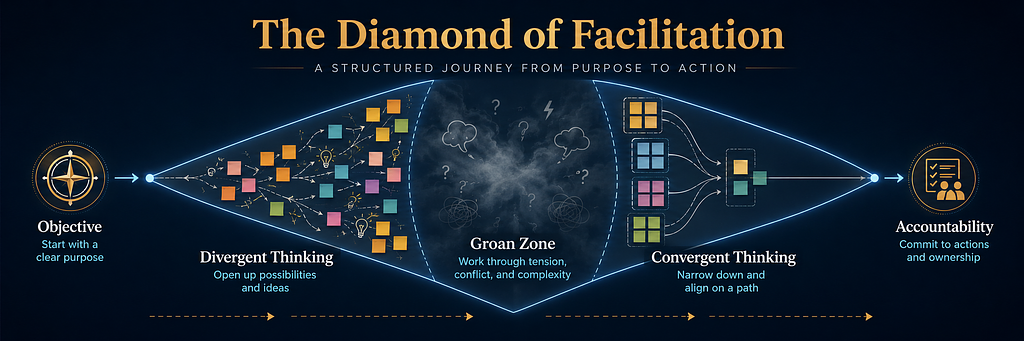
I use the Diamond of Facilitation framework to explain how a well-structured session works:
Objective → Divergent Thinking → Groan Zone → Convergent Thinking → Accountability
Let's go back to that Sprint Planning case. Here's how it plays out in a situation like this:
Start with a clear objective. In this case, the root cause of the tension is a lack of transparency. So the objective becomes: achieve transparency, clarity, and team ownership around how decisions are being made. Whether it's backlog prioritisation, technical choices, or ways of working, the same principle applies. When people don't understand the reasoning, they won't own the outcome.
Open with divergent thinking. This is about laying all options on the table, no filtering, no judging yet. The team explores possibilities: How can we be more transparent? How can we take real ownership? What does responsible AI use look like in our process?
This is where AI can genuinely help. We can prompt AI: "Give me ideas to facilitate this situation." AI can generate a rich set of facilitation options and creative techniques that we can then draw from. This is AI as a thinking partner, not a decision-maker.
Navigate the Groan Zone. After divergent thinking comes the uncomfortable middle, the groan zone. This is where different perspectives in the team collide and people wrestle with ideas they don't fully agree on. It's messy. It's tense. And I want to be emphatic: don't avoid it.
The groan zone is where teams grow. Teams that face conflict rather than sidestep it become more mature, more cohesive, and ultimately more effective. Our role as Scrum Master here is not to rescue the team from discomfort, but to hold the space, setting a time boundary so the tension doesn't drag on indefinitely.
Move into convergent thinking. Now the team narrows down. Out of all the ideas generated, which path will they commit to? Again, AI can support here, suggesting decision-making techniques like dot voting, Roman voting, or other creative methods to make the convergence process engaging and inclusive for everyone.
End with accountability. Whatever the team decides, we ensure they own it. Fully.
What Might the Team Actually Decide?
As a Scrum Master, I don't pre-load the session with an expected outcome. But there are two likely possibilities worth considering:
One outcome from the Sprint Planning case is that the team asks Product Owner for greater transparency around how AI is being used, what prompt did the Product Owner ran and once that transparency exists, they're comfortable moving forward and taking ownership of the outcome.
Another outcome is that the team decides AI shouldn't be involved in that particular decision at all, that human judgment must remain central to the process.
And there could even be a third way, something in between that nobody has mapped out yet.
In fact, when we talk about this "The Invisible Hand in Sprint Planning" case study in PSM AI Essentials class, I once had a participant raise exactly that possibility in a recent session, and they were absolutely right to. The point is: it doesn't matter which outcome they reach. What matters is that the team reaches it together and owns it.
In fact, when we talk about this "The Invisible Hand in Sprint Planning" case study in PSM AI Essentials class, I once had a participant raise exactly that possibility in a recent session, and they were absolutely right to. The point is: it doesn't matter which outcome they reach. What matters is that the team reaches it together and owns it.
The Boundary: Suggestions, Not Solutions
This brings us to the most important principle I want you to take from this discussion.
When it comes to facilitation, we ask AI for suggestions, never for solutions.
The solution must come from the humans in the room. We are in control. We direct AI with intention, using it to expand our facilitation toolkit, spark ideas, and surface creative techniques. But the actual work of reading the room, holding space, navigating tension, and building accountability? That's irreducibly human.
AI can tell you ten ways to run a dot-voting exercise. It cannot sit with a team in their discomfort and help them find their way through it.
Key Takeaways for Scrum Masters
Here's what I want every Scrum Master who just read this blog to walk away with:
Facilitation is not moderation. It's about enabling decisions and holding people accountable, which requires human presence and judgment.
AI is a tool for divergence and convergence support. Use it to generate facilitation ideas and decision-making techniques. Don't use it to replace the facilitator.
The groan zone is your friend. Don't smooth it over. Contain it with a time box, but let it happen. That's where the real team development occurs.
Start every session without a predetermined answer. Your job is to serve the group's decision, not impose your own.
Control stays with you. You tell AI what you need. AI doesn't tell you what to do.
As AI becomes more deeply embedded in how Scrum teams operate, our facilitation skills as Scrum Masters don't become less relevant, they become more essential. The invisible hand only becomes a problem when no one is willing to make human decisions transparent and accountable. That's our job, and it's one that AI simply cannot do.
Related reading
Jun 18, 2026
Why AI Will Replace Level 1 Scrum Masters (And Make Level 5 Irreplaceable)
There is a conversation happening in every LinkedIn thread about Scrum right now, and it goes som...
Jun 11, 2026
Scrum Master Role in Mentoring Teams for AI Fluency
The Art of Wearing Different Hats A skilled Scrum Master is not a one-dimensional facilitator. ...
May 25, 2026
Governing AI in Scrum Teams: Why the Scrum Master Role Has Never Mattered More
Imagine your team just delivered a Sprint at a pace that felt almost too good to be true. The cod...