Sarah has spent seven years as a Business Analyst.
She is good at her job. Really good. She knows how to gather requirements that a development team can actually build from, how to translate stakeholder needs into functional specifications, how to spot a scope gap before it becomes a project crisis.
Then one Tuesday afternoon her manager pulls her aside.
There is a new initiative. A product her organisation is betting on. And they want her to lead it, not as a BA gathering requirements, but as a Product Owner setting direction, owning the backlog, and being accountable for the value the product delivers.
Sarah stares at her laptop that evening. Seven years of refining her analytical instincts, building stakeholder relationships, and mastering the craft of capturing what people say they want. And now she is being asked to do something fundamentally different: to decide what should be built, to hold the vision, to own the outcome.
She feels something she has not felt in years. Not unqualified exactly. But uncertain. Like she has been handed the wheel of a vehicle that handles nothing like the one she knows.
Here is what nobody tells Sarah in that moment. The job title she is being handed comes in five very different versions. And most people given that title without proper preparation end up in the least valuable one: the Scribe.
She has two choices.
Step into the role and gradually become another Scribe Product Owner, writing tickets, managing Jira, and attending ceremonies while someone else drives the actual product decisions. Or deliberately build the capabilities of the type of Product Owner her organisation actually needs: the Entrepreneur.
This course is the deliberate path.
🔥 There are five types of Product Owner. Most organisations are paying for the wrong one.
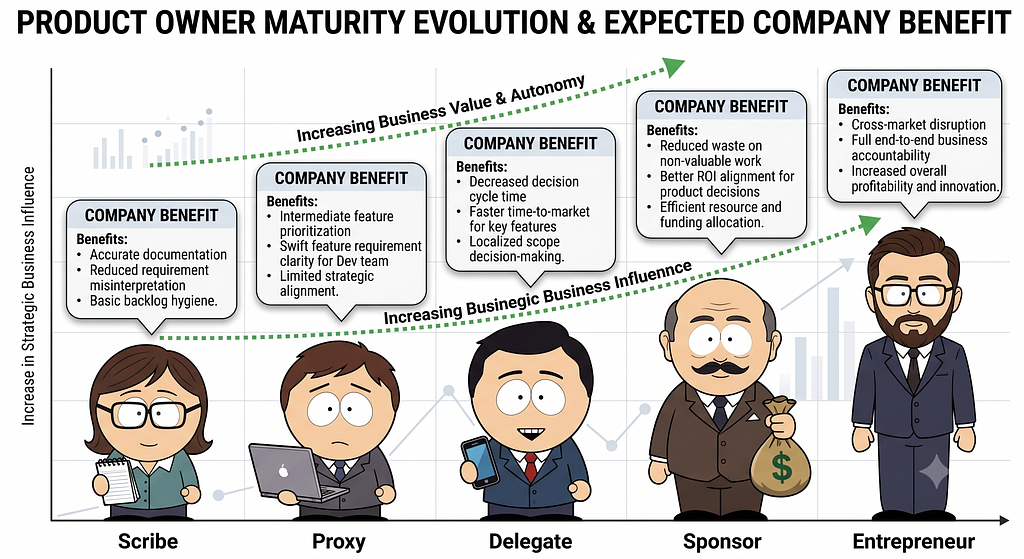
At Scrum.org, we recognise five distinct types of Product Owner on a spectrum from least to most valuable. Understanding where you are on that spectrum, and how to move right along it, is the single most important thing a new Product Owner can do.
Maturity_PO_Enhanced.png8.36 MB
The Scribe is the most common type and the most at risk. Their days are filled with writing acceptance criteria, updating tickets, and facilitating ceremonies. They are organised and thorough. But they are not setting direction, influencing strategy, or making decisions that compound over time. And here is the uncomfortable truth: writing, organising, summarising, and refining are precisely what AI now does well. The Scribe is not being replaced by a smarter human. They are being replaced by a well-prompted AI model.
The Proxy passes stakeholder requests to the team and team questions back to the stakeholders. They do not say no. They do not prioritise based on value. They are a messenger, not a decision-maker. Like the Scribe, their core function is largely logistical, and AI handles logistics.
The Delegate brings genuine domain knowledge and user insight, which is why so many Business Analysts land here when they transition to the Product Owner role. They know the product well. But they lack the organisational authority to make hard trade-off decisions without escalating. They are knowledgeable but not truly accountable.
The Sponsor has budget authority and a seat at the senior table. But they often ask the wrong question: are we on budget? A budget is not a goal. It is a resource. What matters is the value that resource produces.
The Entrepreneurial Product Owner is what every organisation actually needs, and the type that AI elevates rather than threatens. They own a product vision, take calculated risks, run experiments to reduce uncertainty, and optimise relentlessly for the return on every product investment. They make decisions that compound. A great product vision pursued consistently over three years creates more value than a thousand perfectly written user stories.
The gap between a Scribe and an Entrepreneur is not a matter of personality. It is a matter of mindset, empowerment, and skill. All three are learnable. This course builds all three.
🎯 What makes this course different from simply reading the Scrum Guide
🏟️ You shift from Scribe to Entrepreneur, deliberately. Most Product Owner training teaches you what the role looks like. This course teaches you how to operate at its most valuable level. You will map your current Product Owner type, understand what is holding you at that level, and leave with the specific capabilities that move you toward the Entrepreneurial end of the spectrum.
⚖️ You understand the difference between accountable and responsible. The Entrepreneurial Product Owner is accountable for value. That means you can delegate activities, but you remain on the hook for the outcome. This is the distinction that separates the Scribe and the Proxy from everyone above them. As one participant in a recent cohort put it: "I can delegate the customer interview, but I cannot delegate the judgement that comes from it." That is the shift this course is designed to make permanent.
🔍 You discover that starting with the problem makes you more creative, not less. Scribe Product Owners manage features. Entrepreneurial Product Owners own problems. When you anchor your product in the problem it is solving rather than the features it is shipping, your team stops seeing themselves as ticket-completers and starts seeing themselves as problem-solvers. You practise this shift in real exercises using your own product context, not a hypothetical case study.
⚡ You learn to know your customer at a depth that changes how you prioritise. Customer interviews, proto-personas, the Value Proposition Canvas, the Business Model Canvas. You will grapple with a question that trips up many practitioners making the BA-to-PO transition: should you be doing the customer interview yourself, or should you be delegating it and making decisions from the transcript? The answer is not what most BAs expect, and it reveals a lot about how Entrepreneurial Product Owners manage their time.
🧠 You work with the value metrics that most Scribe and Proxy Product Owners never touch. Evidence-Based Management gives you four dimensions (Current Value, Unrealised Value, Ability to Innovate, and Time to Market) and the metrics within each that tell you whether your product is actually succeeding or just shipping. Innovation Rate. On-Product Index. Usage Index. Installed Version Index. These are the metrics of an Entrepreneur, not a Scribe.
🎭 You practise the decisions that only an Entrepreneurial Product Owner makes. Larry says no Product Backlog is needed because the new system should just replicate the old one. Five directors cannot agree on strategic direction and the product has not shipped anything in five months. David presents a different backlog at Sprint Planning than the one everyone agreed on. You work through the cases, the tensions, and the decisions. Not as an observer. As the accountable Product Owner.
🛡️ You understand the Scrum framework from the inside. Not as a set of rules to comply with but as a system designed for complexity. Product development lives in the complex domain, where requirements, technology, and people are all unpredictable, and where empirical process is the only honest response. You leave understanding why Scrum is structured the way it is, not just what its events and artefacts are called.
🔄 You build a layered goal structure that connects vision all the way to tomorrow's daily plan. Scribes manage backlogs. Entrepreneurs hold visions and use goals to pursue them. You will work through the full hierarchy: company vision, product vision, product goal, sprint goal, and daily goal. Each layer has a different job. Confusing them is one of the most common mistakes Product Owners make when they step up from a BA role. In this course you craft goals at each layer for a real product and leave with a practical technique for rewriting output-driven goals into outcome-driven ones that actually focus a team.
🚀 You leave knowing what to own and what to delegate. Entrepreneurial Product Owners are not the ones who do everything. They are the ones who know exactly what only they can do, and who delegate everything else without losing accountability. You will map every major Product Owner activity against that test and leave with a clear mental model for how to spend your time as you move up the spectrum.
💡 What this training is built on
The Professional Scrum Product Owner course is the official Scrum.org certification programme for Product Owners, developed and maintained by the organisation co-founded by Ken Schwaber, co-creator of Scrum.
This is not a course that teaches you to be a better Scribe. Every topic is chosen and sequenced to move you toward the Entrepreneurial end of the Product Owner spectrum, grounded in the Scrum framework, the empirical mindset behind it, and the product management thinking that makes it work in practice.
What makes this particular delivery different is that the content is brought to life through the real tensions participants face in their own organisations. In a recent cohort, teams worked through questions like: how do you balance competing product goals across multiple product managers when everyone has their own backlog? What do you do when sales is driving the roadmap instead of the market, and how do you hold the line on quality without losing the relationship? How do you write an outcome-focused sprint goal when your team is pulling tasks straight from the backlog and calling that a plan? These are the conversations that separate a Scribe from an Entrepreneur, and this course is where you have them.
You will work through:
Agile Product Management and the Product Mindset shift from Scribe to Entrepreneur
Value-Driven Development and how to measure what your product is actually worth
Scrum Theory, Empiricism, and Complexity: why the framework is built the way it is
The Scrum Framework in full: accountabilities, artefacts, events, and commitments from the Product Owner's perspective
Product Backlog Management: refinement, ordering, transparency, and the living artefact that holds the product's future
Releases and Forecasting: how to communicate progress honestly and plan with appropriate confidence
And throughout, you will do exercises. Real ones, with stakes, with debrief, and with learning that sticks.
📚 What you will learn, section by section
🌱 Agile Product Management
A product is not a project. That sounds obvious, and yet most organisations, and most Product Owners, still operate with a Scribe or Delegate mindset underneath the agile language.
You will work through what it actually means to shift from output to outcome, from scope and timeline to vision and value, from managing requirements to owning the product's success. You will map the full landscape of product management activities (strategy, discovery, planning, execution, measurement, retirement) and understand which of them require direct Product Owner ownership, which can be delegated while accountability stays with you, and which should be handed off entirely so you can focus on the work that moves the product forward.
A question that comes up in every cohort is: what should the Product Owner actually do themselves? The answer is more revealing than most people expect. Creating a list of features is operational and can be delegated. Establishing the product roadmap requires collaboration, but accountability stays with you. Crafting the product vision is yours and yours alone. You will work through where each activity sits and why, grounded in the real tensions that arise when engineering, sales, and leadership all think they should have the deciding vote.
You will also meet your customers properly. Proto-personas. Customer interviews. The Value Proposition Canvas. The Business Model Canvas. The Lean Canvas. Not as templates a Scribe fills in once and files away, but as thinking tools an Entrepreneur returns to every time they are not sure whether they are building the right thing.
💰 Value-Driven Development
The Scribe Product Owner measures a productive week by the number of tickets created. The Entrepreneurial Product Owner measures it by the value the product moved toward delivering.
You will work through Evidence-Based Management's four dimensions of value, the metrics within each, and the failure modes that keep Product Owners operating at the wrong level: measuring velocity instead of outcomes, accepting business value numbers handed down from above without interrogating them, and defining features as value rather than asking what behaviour change the feature is meant to create.
One of the most revealing exercises in this section asks you to look honestly at your own OKRs and ask: are these outcome-driven, or are they just activities dressed up as goals? In a recent cohort, a participant realised mid-exercise that their key result was phrased entirely as an output. The rewrite took ten minutes. The shift in how the team understood their purpose took the rest of the day. That is the kind of thinking this section unlocks.
You will also understand why staying in the complex problem space is not a burden but a strategic advantage, and why the organisations that fell from dominance, Nokia, BlackBerry, Boeing after its cultural shift, all made the same mistake: they stopped challenging the status quo from the inside before someone else challenged it from outside.
🔬 Scrum Theory and Empiricism
Product development is complex. Requirements change. Technology surprises you. People are people. The only honest response to complexity is an empirical process, built on transparency, inspection, and adaptation rather than the pretence that you can plan your way to certainty at the start.
You will understand the Cynefin framework and Ralph Stacey's complexity model and why product development sits firmly in the complex domain. Simple, repeatable problems are increasingly handled by machines and AI. The work that remains for human product teams is genuinely unpredictable work, where the only honest approach is to inspect and adapt your way forward.
You will also address one of the most common misunderstandings about Scrum as AI tools reshape the development landscape: the sprint is not a delivery cadence. It is an alignment and planning cadence. When your team can ship code faster than ever before, the sprint's job becomes more important, not less, because speed without direction is just expensive chaos. An outcome-focused sprint goal is what gives that speed somewhere meaningful to go.
🏗️ The Scrum Framework
You will work through the Scrum framework in full, from the Entrepreneurial Product Owner's perspective. Every accountability. Every artefact and its commitment. Every event and what the Product Owner's job is within it.
This is not a recitation of the Scrum Guide. You will work through real scenarios: the Product Owner who lets competing directors paralyse the backlog, the manager who insists there is no need for a backlog on a rewrite project, the Product Owner who brings a different backlog to Sprint Planning than the one the team agreed on. These are the moments that reveal whether a Product Owner is a Delegate who escalates or an Entrepreneur who decides.
You will also understand the full goal hierarchy that gives Scrum its structure: how the product vision informs the product goal, how the product goal informs the sprint goal, and how the sprint goal guides the daily scrum. When these layers are clear, alignment happens naturally. When they are confused, the team works hard and drifts. This course makes them clear.
📋 Product Backlog Management
The Scribe sees the Product Backlog as a requirements list to be maintained. The Entrepreneur sees it as a living strategic tool: ordered, transparent, and continuously refined in service of a product goal worth pursuing.
You will learn what makes a Product Backlog healthy: ordered by value, sized appropriately, refined continuously, and transparent to the entire Scrum Team and stakeholders. You will practise the techniques (story mapping, backlog ordering, value and risk weighting, experimentation) that turn a backlog from a ticket queue into an instrument of product strategy.
A critical insight this section surfaces: your sprint goal should not be pulled from the backlog. It should be derived from the product goal. The backlog holds options, not commitments. When Product Owners build their sprint goals by scrolling through backlog items, they end up planning like a Scribe. When they start with the product goal and ask what outcome they need to move toward this sprint, they start leading like an Entrepreneur.
You will also learn the hardest part: knowing when to say no, when to reorder without politics, and when to delete items that have lost their reason to exist.
📈 Releases and Forecasting
A product that never reaches a customer creates no value. Releases are not milestones in a project plan; they are the mechanism by which value is realised, feedback is gathered, and the Entrepreneurial Product Owner learns whether their bets were right.
You will understand how to plan releases with honest confidence rather than false precision, how to use flow metrics and release burn-ups to communicate progress to stakeholders, and how to manage the tension between the stakeholder who wants a firm date and the empirical reality of complex product development.
🙋 Who this training is perfect for
✅ Business Analysts stepping into a Product Owner role who want to arrive as a Delegate or higher, not as a Scribe with a new job title ✅ Scribe or Proxy Product Owners who know they are operating below their potential and want the frameworks and confidence to move up the spectrum ✅ Proxy Product Owners and Business Representatives performing Product Owner duties without the decision-making authority or clarity they need to be effective ✅ Scrum Masters who want to better support Product Owners by understanding what Entrepreneurial product ownership actually looks like in practice ✅ Managers and leaders who want to understand the difference between the five types of Product Owner and how to create the conditions for Entrepreneurial product ownership in their organisation
No prior technical background required. You do not need to understand software architecture, machine learning, or engineering trade-offs. If you can articulate a business problem, work with stakeholders, and think clearly under uncertainty, you have everything you need to walk into this course.
🏆 What you will walk away with
By the end of this course, Sarah and you will have something most people handed the Product Owner title never get: a clear understanding of what separates a Scribe from an Entrepreneur, and the practical ability to operate at the right end of that spectrum.
🚀 A decisive shift in how you see the role. You will leave knowing which type of Product Owner you are today, which type your organisation needs, and exactly what it takes to close that gap. That clarity changes every product decision you make from here forward.
🌍 An outcome mindset you will never unlearn. The shift from output to outcome, from project to product, from capturing requirements to owning value. Once you see it, you cannot unsee it.
🔭 A goal hierarchy that connects strategy to daily work. Product vision. Product goal. Sprint goal. Daily goal. You will leave knowing how to craft each layer, how to identify when one has slipped back to output-driven thinking, and how to rewrite it so your team knows not just what to build but why it matters.
📊 The value metrics of an Entrepreneurial Product Owner. Evidence-Based Management. Innovation Rate. On-Product Index. Usage Index. Installed Version Index. Not the metrics of a Scribe counting tickets, but the metrics of someone accountable for a product's return on investment.
🛠️ A full practical toolkit for every stage of the product lifecycle. Customer interviews, proto-personas, the Value Proposition Canvas, the Business Model Canvas, the Lean Canvas, story mapping, backlog ordering techniques, experimentation approaches. A repertoire you can reach for the next morning.
⚖️ Clarity on what to own and what to delegate. Entrepreneurial Product Owners are not the ones who do everything. They are the ones who know exactly what only they can do. You will leave with that mental model fully formed.
🎓 A globally recognised certification included. A free PSPO I certification attempt is included with this course. Sit within 14 days and a second attempt is available at no extra cost if you need it. The majority of participants pass on their first attempt.
💪 The confidence to lead the product, not just administer it. You came in as someone who has been handed a new accountability. You leave as a Product Owner who understands what the Entrepreneurial version of that role demands, with the frameworks, the language, and the experience to exercise it with authority.
✨ The transformation promise
You came in as Sarah, a skilled and experienced Business Analyst who has been asked to become something different.
There are two versions of what "something different" can mean. The first is a Scribe Product Owner with a new job title: writing better tickets, managing a bigger backlog, attending more ceremonies. The second is an Entrepreneurial Product Owner: holding the vision, owning the outcome, making the decisions that compound, and building the product her organisation actually needs.
This course is how Sarah becomes the second one. And so can you.
From Scribe to Entrepreneur. That is the journey. This is where it starts.
Spaces are limited for this interactive session. Every cohort is kept small so every participant gets real practice time, real debrief, and real feedback from real product scenarios, not from case studies you read and discuss, but from exercises you do.
👉 Register now and take the first step from Scribe to Entrepreneur.
"Thoroughly enjoyed the PSPO virtual training, and found Joshua's coaching style very engaging, collaborative and inclusive. Gave me heaps of confidence when undertaking the PSPO exam, and certainly in product management moving forward!"
"Josh made the training enjoyable by having a friendly demeanour, and really getting to know his participants."
"Josh made the training enjoyable by participant involvement and referencing real life experiences. His light-hearted approach was a breath of fresh air.
His ability to answer any and all questions promptly shows that he really knows the subject matter inside and out."
"Engagement by Joshua was awesome. Providing a Case Study to link back the learning's during the 3 day course really helped drive the discussions.
Joshua's sharing of his experience and research of other companies and Products helped to validate the course material."
"An excellent course. Provides a great understanding of Scrum & the Product Owner.
Joshua was clear & detailed in his explanations, had relevant examples & most of all, knew what he was talking about thru his experiences."